
From November 2025 through to February 2026 I undertook a work placement at the Griffith University Anatomy lab.
Due to the sensitive nature of the work, and to respect the dignity of the incredibly generous body donor, I have only provided descriptions of my work, any images included will not depict any actual cadeveric material.
My WIL placement at Griffith University’s Anatomy Laboratory on the Gold Coast was a concentrated immersion into applied anatomical science, technical skill development, and professional ethics. Entering the placement, I expected to consolidate content knowledge from Anatomy & Physiology 1 and 2, and to gain experience observing cadaveric material.
What I did not anticipate was how much my learning would be shaped by the process of dissection itself: moving through layered structures slowly, making decisions under uncertainty, and repeatedly confronting the reality that the “specimen” is also a person who donated their body to advance education. The placement ultimately developed my anatomical literacy, precision and safety in technical work, and my capacity to work reflectively within a values-led scientific environment.

In the first two weeks, I worked on a prosection plan, outlining specific goals and intended learning outcomes. This planning period initially felt administrative, but in retrospect it was foundational. The plan forced me to translate broad anatomical intentions (“learn the hip region”) into operational targets (“expose the femoral triangle; preserve key neurovascular structures; present tissue planes clearly for teaching”). It also made me confront constraints that are often invisible in textbook learning: time, access, tool limitations, and the need to balance “clean” anatomical display with preservation of delicate structures.
I was assigned a “Lower Quarter”: a human cadaveric specimen cut midsagittally and coronally at the level of the twelfth vertebra. The sectional nature supported spatial understanding because internal relationships were already partially exposed, but it also required careful planning because landmarks could be altered.
I expected the anatomy to perfectly match the diagrams I had researched, however in reality every body contains some level of variation. This was one of the most valuable learnings that I took away from the placement.
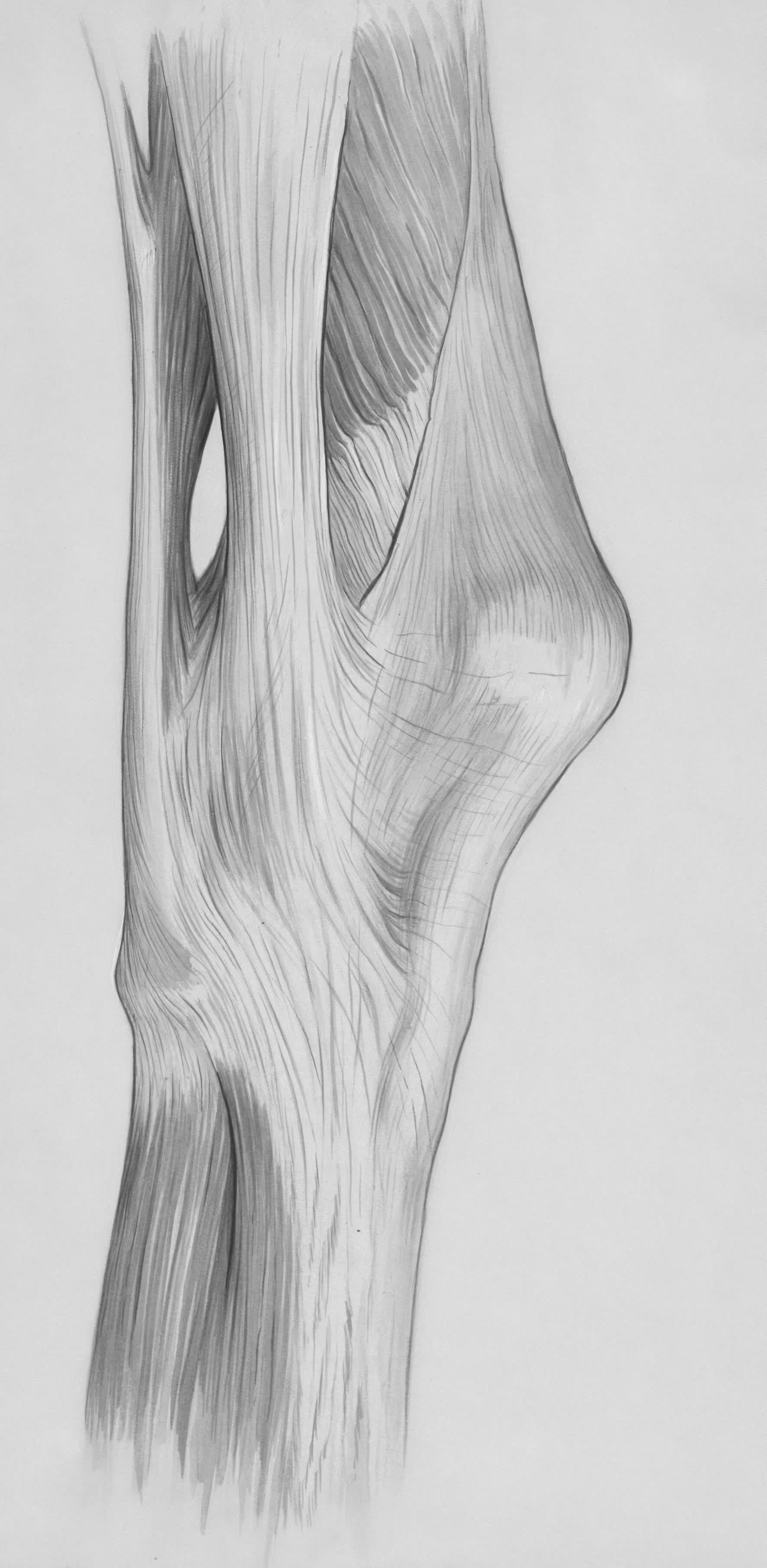
An interesting feature of my experience was the minimal initial technical training (less than two hours) on using a scalpel, resecting skin, and removing adipose tissue. At first I found this a bit daunting, however, it became a catalyst for self-directed learning.
The lack of extended step-by-step instruction meant I had to be deliberate: researching, checking, proceeding slowly, and repeatedly validating decisions against multiple sources. I relied heavily on anatomical texts, particularly Clemente’s Anatomy Dissector and the Photographic Atlas of Anatomy (Rohan J. et al.). I used these as guides for procedural reasoning for example what plane to enter, what structures should appear next, and what errors were likely at each stage.
This process revealed a gap in my knowledge - understanding the difference between knowing anatomy and interacting with the anatomy/ I understood, for example, where structures should be, but I had to learn how to reach them without damaging them.
My prosection began posteriorly. I removed dermal layers and subcutaneous adipose tissue to reveal the gluteus maximus, progressing posterolaterally toward the tensor fascia lata. This work took approximately 16 hours across three sessions. The time requirement itself was instructional. It demonstrated that anatomical clarity is earned through patience and repeated micro-decisions: selecting the right amount of tension, choosing between sharp and blunt dissection, and learning how tissue texture changes as depth increases.
I then moved to the anterior compartment of the hip with the goal of revealing the femoral triangle. I resected dermal layers and used careful blunt dissection through adipose tissue until I identified the greater saphenous vein. I traced it inferiorly to approximately 15 cm above the popliteal region, creating a clean border for presentation.
This phase reinforced a key professional skill: working methodically with a clear endpoint. It made me more aware of how easily a small technical error (for example, cutting too deeply through fat) can permanently remove a learning opportunity by damaging a vessel or nerve.
From there, I progressed deeper, resecting adipose tissue and removing fascial layers to reveal the femoral artery and vein.
The next stage, “cleaning” the region, required a different set of skills. Early on, my instinct was to work quickly to “get to” the important structures. Over time, I learned that cleaning is a painfully delicate process - removing fat around vasculature and musculature until planes are legible.
This process also led me to visualise the femoral nerve, located lateral to the femoral artery and deeply embedded beneath adipose tissue. Preserving small branches required control and the ability to pause and reassess rather than pushing forward. This entire anterior region work took approximately 48 hours over eight sessions, and it marked a genuine improvement in my steadiness and judgement.

The final region I worked on involved dissecting the reproductive organs. Because the specimen was cut perfectly midsagittally, the dissection allowed a clear view of internal organisation once the dermal layers of the scrotum and penis were removed. I carefully resected the testes and displayed key layers, including the parietal layer of the tunica vaginalis and the tunica albuginea, then incised the tunica albuginea to reveal the testis and the head and neck of the epididymis. This was technically challenging.
A particularly formative experience was participating in an embalming process to prepare a donor for future dissection. My role included shaving the donor’s head, inserting a femoral cannula, and making incisions in the big toe, ankle, and thumb.
Watching the body transform during embalming was fascinating from a biological and procedural standpoint, but it also sharpened my ethical awareness. One staff member held the donor’s hand during parts of the process, a gesture that functioned as a quiet act that reinforced the dignity and humanity of the donor.
Across the placement, my scientific education and training were not separate from the work; they were the scaffold that allowed me to learn safely and meaningfully. Anatomy & Physiology 1 and 2 provided the conceptual map, terminology, spatial relationships, and functional context so that the dissection became an active testing ground.
Just as importantly, my time in the placement encouraged an evidence-based approach: consulting resources, verifying assumptions, and treating uncertainty as a prompt for investigation. This mindset helped me develop deeper competence, and it made the placement feel like a genuine extension of scientific practice.
What I valued most was the culture of the department.
I have worked with many organisations that display values on walls; here, the values were visible in daily actions. They were evident in the donors’ generosity, in the staff’s consistent commitment to dignity and respect, and in the collegiality of fellow prosectors who offered feedback and practical tips. This environment shaped not only what I learned, but how I learned: with humility, care, and a sense of responsibility to produce work that honours the donor’s contribution and supports future student learning.
Overall, this placement helped me deeply understand the anatomy of the regions I worked on in a way that I couldn't have possibly achieved through observation alone. My understanding was developed by working through tissue planes, recognising variation, and learning the characteristics of the different structures through interacting with them for hours at a time.
I leave the placement with improved technical skill, stronger anatomical reasoning, and a deeper ethical framework for future work in the medical field.
Most importantly, I now understand that scientific competence in this context is inseparable from respect: precision is a technical skill, but dignity is the standard that gives the work its legitimacy.
Image Credits:
Title: Knee joint Creator: Wetselaar-Whittaker, J Date: 1955-03-12 Providing institution: Universitaire Bibliotheken Leiden Aggregator: Dutch Collections for Europe Providing Country: Netherlands Public Domain Knee joint by Wetselaar-Whittaker, J - Leiden University Libraries, Netherlands - Public Domain. https://www.europeana.eu/item/744/item_3461959
Title: Knee joint Creator: Wetselaar-Whittaker, J Date: 1955-03-11 Providing institution: Universitaire Bibliotheken Leiden Aggregator: Dutch Collections for Europe Providing Country: Netherlands Public Domain Knee joint by Wetselaar-Whittaker, J - Leiden University Libraries, Netherlands - Public Domain. https://www.europeana.eu/item/744/item_3461950
Rare Book Division, The New York Public Library. "Tertia musculorum tabula. [Showing the figure with open hands]" The New York Public Library Digital Collections. 1545. https://digitalcollections.nypl.org/items/510d47dd-f272-a3d9-e040-e00a18064a99
Title: Anatomy of the human muscles, seen from behind Contributors: Pini, Pietro Matteo, (1540-), (inventor) Date: 1744-1761 Providing institution: Leiden University Libraries Aggregator: Dutch Collections for Europe Providing Country: Netherlands Public Domain Anatomy of the human muscles, seen from behind - Leiden University Libraries, Netherlands - Public Domain. https://www.europeana.eu/item/815/item_3280506